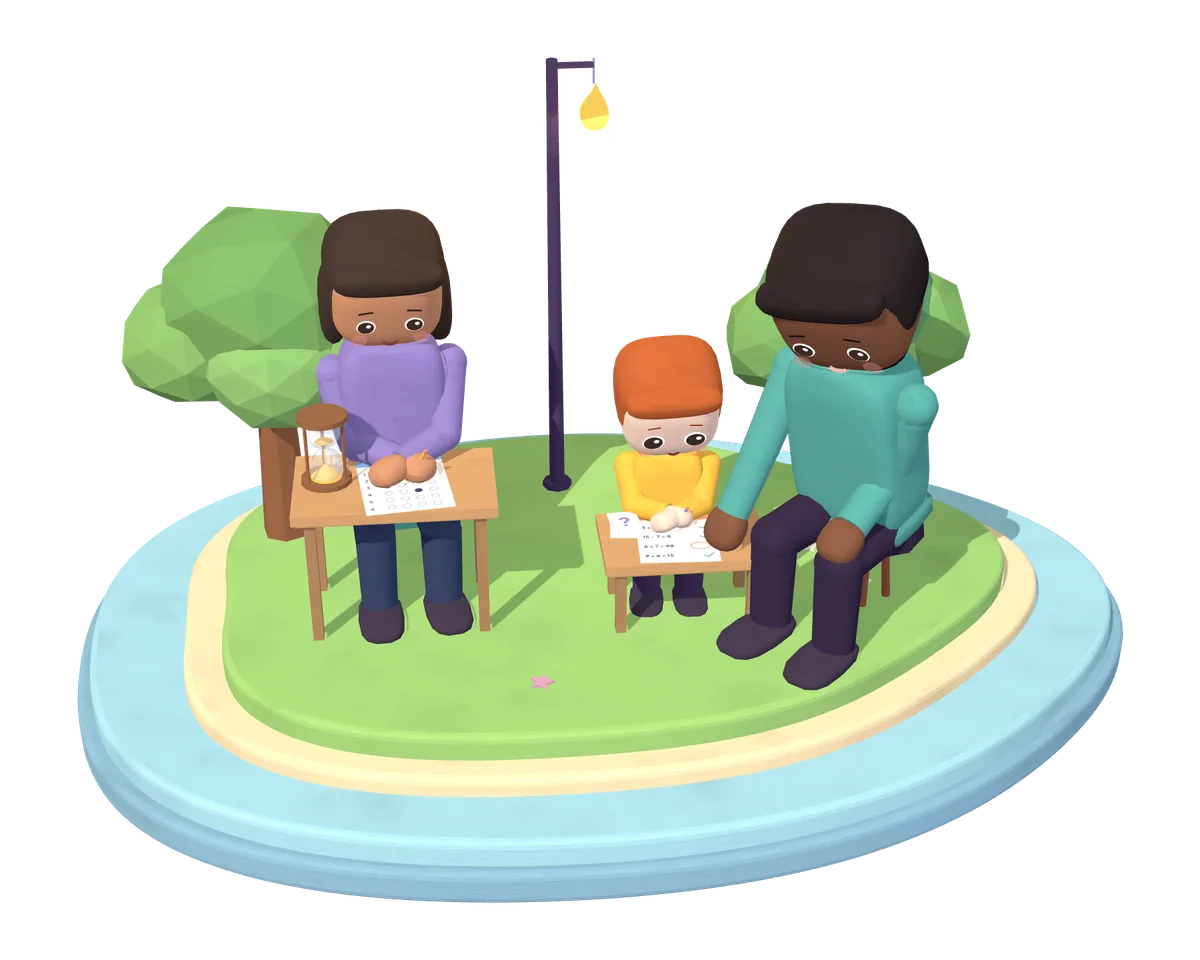

Test prep · Grades 3 to 12
Test prep built on mastery, not cramming.
When a test is coming, we find what it is likely to expose, fix the skills underneath and make the format familiar, so your child walks in knowing what to expect.
- Grades 3 to 12
- EQAO, OSSLT, exams, SAT and ACT
- Mapped to the Ontario curriculum
- Coming soon to Ottawa
Who it’s for
A test shows what’s secure. Better to know before it does.
Situations parents often describe, from Grade 3 to Grade 12.
EQAO is coming, and your child is worried about it.
EQAO assesses the curriculum, so the best preparation is the curriculum, mastered. A calm look at the format takes away the surprise.
Studies for hours, and the marks don’t move.
Rereading notes feels productive. Practice testing and spaced review are rated far more useful.
Knows it at home, freezes on the test.
A skill that works with help may not yet hold alone and against the clock. Recall practice, timed, shows which ones.
Runs out of time on every test.
Pacing, and knowing which questions to do first, are skills, and they can be practised.
The literacy test is in Grade 10, and writing is a struggle.
The OSSLT checks reading and writing up to the end of Grade 9, so that is where we look first.
Thinking about the SAT or ACT for a US university.
A diagnostic with an official practice test shows what the test is likely to expose, and the plan starts there, well ahead of the date.
Recognize your child here? A diagnostic assessment is the first step, and it will be free for founding families. See how Hikmah approaches it
How we prepare
Find what the test will find, before the test does.
The same steps as all Hikmah tutoring, worked back from one date on the calendar.
The diagnostic
What the test is likely to expose
A diagnostic built on what the test covers, in its format, shows what’s secure and what isn’t, before the test does.
The root
The skill under the lost marks
Each miss is traced to the skill underneath, often from an earlier grade. Fixing that comes before any test practice.
The plan
Worked back from test day
A written learning plan for the weeks before: root skills first, then mixed practice, then the format and timing, then a calm last week.
One mentor
The same mentor, before and after
One mentor plans the weeks with your child, knows what makes them nervous and goes through the results with them afterwards.
Mastery checks
Practice tests and spaced review
Short practice tests, mixed problem types and review spread over the weeks, with mastery checks to show what’s secure.
Updates and the +
A progress update, and a habit that lasts
You hear how it’s going every month. The + is your child learning to plan their own preparation, which outlasts any one test.
A session · Test prep · Sana, Grade 11
- Recall warm-upPast units, from memory.
- Trace the missesLast test’s errors, back to factoring.
- Mixed, timed practiceShuffled problem types, timed.
- Mastery checkFresh questions on the root skill.
- Her own planShe sets her own review days.
The tests, one by one
Every test is different. The preparation starts the same way.
What each test is, from the official source, and what Hikmah will do for it.
Grades 3 and 6 · Ontario
EQAO reading, writing and math
Provincial assessments written online at school each spring, aligned with the Ontario curriculum up to the end of Grade 3 or Grade 6. EQAO says that, because of that alignment, students do not require additional preparation.
At Hikmah
- We agree: the curriculum, mastered as the year goes, is the preparation
- A calm look at the format, with EQAO’s own sample test
- No drilling, and no extra pressure at home
Grade 9 · Ontario
EQAO Grade 9 math
Written online near the end of the de-streamed Grade 9 math course (MTH1W). Under Ontario’s 2026 update to Growing Success, it counts as the course’s written exam, worth 20% of the final mark. EQAO says it does not require additional preparation.
At Hikmah
- The course’s skills, mastered unit by unit, root gaps first
- Practice in the online format, with EQAO’s sample test
- Spaced review of earlier units in the last weeks
Grade 10 · Ontario
The OSSLT
The Ontario Secondary School Literacy Test checks reading and writing across subjects up to the end of Grade 9. Students are expected to write it first in Grade 10, and passing it is how most meet the diploma’s literacy requirement. After two attempts, with at least one unsuccessful, a student can take the literacy course (OSSLC) instead; the principal can explain the options. French-language schools write the TPCL.
At Hikmah
- Reading and writing, built up from where your teen is
- EQAO says it needs no extra preparation: its practice test, for the format
- If a second try or the OSSLC comes next, a plan for that too
Grades 9 to 12 · Course marks
Unit tests, culminating tasks and final exams
Under Ontario’s Growing Success policy, updated for 2026–27, a final mark is 65% classroom work, a mandatory final evaluation (20% in Grades 9 and 10, 25% in Grades 11 and 12) and attendance and participation. In most English, math and science courses the final evaluation is a written exam in the exam period (in Grade 9 math, the EQAO test); in many other subjects it is split with a culminating task.
At Hikmah
- A plan worked back from each test and exam date
- Mixed practice and timed practice tests in the course’s format
- Spaced review, so earlier units are fresh for the exam
Ontario: Growing Success and its 2026 update (opens in a new tab)
High school · US universities
The SAT and the ACT
The SAT is digital, taken in College Board’s Bluebook app: a Reading and Writing section and a Math section, each adapting its second half to how the first went, 2 hours and 14 minutes in all. The ACT tests English, math and reading, with science and writing optional. Check each college’s own policy on test scores.
At Hikmah
- A diagnostic with an official practice test
- The root skills first: algebra, close reading, grammar
- Free official practice, then timed sections in the real format
High school · Advanced courses
AP and IB exams
AP exams are written in May and scored 1 to 5; many US colleges grant credit or placement for 3 and above, and each sets its own policy. In the IB Diploma Programme, written exams at the end of the programme are the basis of most courses’ assessment, alongside work marked by teachers and moderated by the IB; subjects are graded 7 to 1.
At Hikmah
- Mastery unit by unit, all year, not in April
- Practice questions in the exam’s format
- Feedback on long written work that stays your teen’s own
Formats, dates and rules change from year to year. Check the official page on each card before you plan.
How it’s different
Cramming fills the night before. Mastery fills the weeks before.
Cramming feels like hard work, which is why it’s tempting. Here is how it compares with a Hikmah test-prep session.
| Cramming | Tutoring+ | |
|---|---|---|
| Starts with | The test date and a stack of review sheets | A diagnostic of what the test is likely to expose |
| Works on | Likely questions, one type at a time | The root skills first, then mixed problem types |
| Between sessions | Rereading notes | Short practice tests and review spread over weeks |
| The last week | As much as possible, as late as possible | Light review, sleep and a calm plan |
| After the test | On to the next one | The misses traced, so the next test can start stronger |
Illustrative example. Session plans and lengths will be shared with founding families before we open.
What you receive
You’ll know what the test covers, and what’s already secure.
Plain words from the mentor who planned the weeks with your child.
- After the diagnostic
- What the test covers, what’s secure, what isn’t and where each gap began.
- A written learning plan
- The weeks before the test, worked back from the date: root skills first, then mixed practice, then format and timing.
- A progress update every month
- Skills mastered, how the practice tests went and what’s next.
- A mentor to talk to
- The same person before and after the test, who goes through the results with your child.
The research behind it
Rereading feels like studying. The research favours practice tests.
Hikmah hasn’t opened, so we have no results of our own yet. Here is what other researchers found about how to prepare.
Practice tests, not rereading
A review of ten common study techniques rated practice testing and distributed practice (spreading study out over time) as high utility, and rereading and highlighting as low utility.
At Hikmah: Test prep at Hikmah will be practice questions and spaced review, never an evening of rereading notes.
Recall makes it last
In lab experiments with university students, those who practised recalling a prose passage remembered more of it a week later than those who reread it, though rereading did better on a test five minutes later.
At Hikmah: Sessions will open with recall from memory, and mastery checks will be short, frequent and low-stakes.
Spaced review
A review of 317 experiments, mostly with adults learning words and facts, found that spacing study out over time led to better recall than massing it into one sitting.
At Hikmah: The plan will spread review over the weeks before a test, and come back to each skill weeks after it was mastered.
Mixed practice
In a randomized trial in 54 Grade 7 math classes, students who practised mixed problem types scored 61% on a surprise test a month later, against 38% for those who practised one type at a time.
At Hikmah: Once a skill is secure, practice will mix problem types, as a real test does, so your child learns to choose the method.
Questions from parents
What parents ask about test prep.
Will test prep raise my child’s score?
We won’t promise a score; no one honestly can. What we will show you is which skills the test depends on, which were shaky, which are now secure on a mastery check and how the practice tests went.
EQAO says students don’t need extra preparation. Do you agree?
Yes. EQAO’s assessments are based on the Ontario curriculum, so the best preparation is mastering the curriculum as the year goes. For Grades 3 and 6, we will add a calm look at the format, using EQAO’s own sample test, and nothing more. For Grade 9 math, which also counts as the course’s exam, the plan will follow the course, with spaced review in the last weeks.
How early should we start?
The diagnostic shows how much there is to do. Getting used to a format is quick; a root gap from an earlier grade takes longer. For a final exam or the SAT, starting well ahead leaves room for spaced review instead of cramming.
My child gets anxious before tests. Can you help?
We will help with what we can: secure skills, practice in the real format so nothing is a surprise, and a plan for the last week that makes room for sleep. If worry is getting in the way of daily life, talk with your child’s school or your family doctor too.
Do you prepare teens for the SAT and ACT?
Yes, for teens applying to US universities. The diagnostic will use an official practice test to see what the test is likely to expose, the plan will fix those skills first, and practice will move to timed sections in the real format. Which test, and when, is for your teen and your family to decide.
Do you teach to the test?
We will teach the course and the skills underneath it. The format gets attention near the end, so it holds no surprises, but the work is mastery, and that lasts past the test.
Can test prep be in French?
Yes. Sessions will be in English or French. Students in French-language schools write the TPCL instead of the OSSLT; the approach is the same. How sessions in French will run will be shared with founding families before we open.