
Adaptive learning
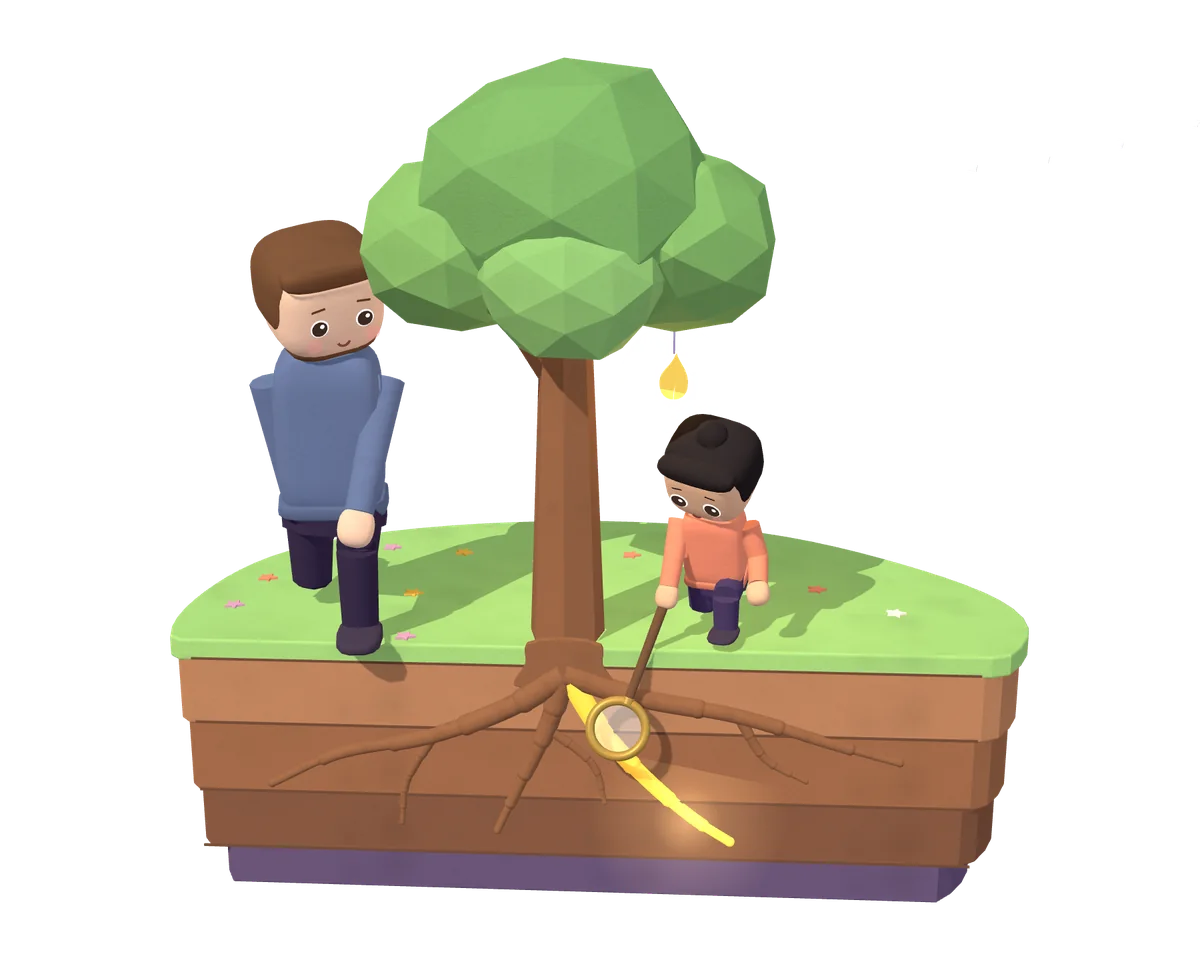
Every gap has a root. We find it first.
When your child struggles with something new, the cause is often something older. Our tutoring finds that skill, fixes it and checks again.
At a glance
Three things that change for your child.
Tutoring that starts at the cause, not at this week’s worksheet.
The real cause, found
A diagnostic assessment and short checks trace a struggle to the skill underneath, often from an earlier grade.
Time spent where it counts
Practice goes to the root skill, not to more of what your child already knows or can’t do yet.
Skills that hold
Fresh questions show a skill is mastered, and it comes back weeks later so it lasts.
The mastery map
Every skill stands on others.
Adding fractions rests on equivalent fractions, which rest on multiplication facts. Skills are built on skills, all the way down.
Each child’s map is built from their diagnostic and every check since, and follows the Ontario curriculum for their grade.
How the platform builds each mapRoot found
Multiplication facts
Grade 3 · Rests on
What her mentor does nextThree short lessons on the 6, 7 and 8 times tables, with patterns she can see, then a fresh check.
The root-cause loop
Find the cause. Then make it last.
Follow Zoe, in Grade 6, from one missed question to a skill that holds. Run the loop a step at a time.
Her mastery map
- Grade 6Adding fractions with different denominatorsMissedMissedMissedMasteredMastered
- Grade 5Equivalent fractionsShakyWorking onMasteredMastered
- Grade 4Multiplication facts: 6s and 7sRootWorking onMasteredMastered
- Grade 3Fractions as equal partsSecureSecureSecureSecure
A short mastery check
Zoe misses two of three questions on adding fractions. The pattern in her answers matters more than the score.
Mastery check · adding fractions
- 1/2 + 1/3 =2/5
- 2/3 + 1/4 =3/7
- 1/4 + 2/4 =3/4
The pattern
She adds the tops and the bottoms when the pieces aren’t the same size.
Back to the skill underneath
Quick probes on earlier skills find where it breaks: equivalent fractions wobble, and her 6 and 7 multiplication facts aren’t secure.
Probes on earlier skills
Equivalent fractions
- 1/2 =3/6
- 2/3 =8/12
- 5/6 =30/42
Multiplication facts
- 6 × 4 =24
- 6 × 7 =48
- 7 × 8 =54
Root found
Her 6s and 7s aren’t secure, so finding a common denominator is guesswork.
Fix the root first
Her learning plan puts the facts and same-sized pieces first, in short, focused blocks with her mentor.
Learning plan · the next two weeks
- FirstMultiplication facts: 6s and 7s, a short recall every day
- ThenSame-sized pieces: fraction strips, then common denominators
- LastAdding fractions, worked through with her mentor
Fresh questions, same skill
Back to adding fractions, with questions she hasn’t seen. All three are right: mastered.
Mastery check · fresh questions
- 2/5 + 1/3 =11/15
- 3/4 + 1/6 =11/12
- 1/2 + 2/7 =11/14
Mastered
Come back, so it lasts
The skill comes back after one week, then three, then seven, further apart each time.
Spaced revisits
Every visit uses new questions.
Illustrative example.
For your family
You’ll know what changed, and why.
Every month, a progress update in plain words: what your child mastered, the cause we found and what comes next.
Hikmah Tutoring+
- Catching up now
- If your child is falling behind in math, reading or writing, the loop starts at the gap, often a skill from an earlier grade, with every skill mapped to the Ontario curriculum.
- Ready for later
- Each fixed root makes the next skill easier, so your child can move ahead of grade on solid ground.
Progress update
NovemberThis month
Zoe mastered adding fractions with different denominators.
The cause we found
Her mistakes traced back to equivalent fractions and her 6 and 7 multiplication facts. We fixed those first, and her mastery check came back clean.
Skills
- Adding fractionsMastered
- Equivalent fractionsMastered
- Multiplication facts: 6s and 7sMastered
- Comparing fractionsNext
Try at home
Ask her why 1/2 + 1/3 isn’t 2/5. She’ll draw you the pieces.
The difference
By the calendar, or by mastery.
Homework help and test drills work on the question in front of your child. We start with the cause, and move on when it’s mastered.
We expect fixed root gaps to show up in schoolwork and on the report card. We aim for that; we don’t promise marks.
Where it starts
The usual wayThis week’s worksheet
At HikmahA diagnostic assessment that looks back through earlier grades
A missed question
The usual wayMore of the same practice
At HikmahTraced back to the skill underneath
Before a test
The usual wayDrilling practice tests
At HikmahMastery checks with fresh questions, spaced over weeks
When to move on
The usual wayWhen the unit ends
At HikmahWhen a mastery check shows they really get it
What you hear
The usual wayA mark
At HikmahThe cause, the fix and what comes next
The research
What the research says. And what we’ll measure.
Hikmah hasn’t opened, so we have no results of our own yet. Here is the published research behind mastery, tutoring and practice that lasts, and what we’ll track from the first day.
Meta-analysis · 108 evaluations
Mastery learning
Moving on only after mastering each step, with feedback and correction, raised final exam scores by about half a standard deviation on average (0.52): roughly from the 50th to the 70th percentile. These were course exams, and 91 of the 108 evaluations were college courses; on standardized tests the effects were much smaller.
Kulik, Kulik and Bangert-Drowns (1990). Effectiveness of mastery learning programs: A meta-analysis. Review of Educational Research, 60(2), 265–299. Read the source (opens in a new tab)
Meta-analysis · 89 randomized trials
Tutoring, from preschool to Grade 12
Tutoring raised achievement by about 0.29 standard deviations on average, in reading and in math. Effects were largest in the early grades, in programs meeting at least three times a week, and with teachers or trained paraprofessionals.
Nickow, Oreopoulos and Quan (2024). The promise of tutoring for PreK–12 learning: A systematic review and meta-analysis of the experimental evidence. American Educational Research Journal. Read the source (opens in a new tab)
Classic study · A classic study and a review
One to one, measured honestly
Bloom reported that students tutored one to one with mastery learning outperformed a regular class by about two standard deviations. A later review of controlled studies found smaller, still large effects: about 0.79 for human tutors and 0.76 for step-by-step computer tutors.
Bloom (1984). The 2 sigma problem: The search for methods of group instruction as effective as one-to-one tutoring. Educational Researcher, 13(6), 4–16. Read the source (opens in a new tab)
VanLehn (2011). The relative effectiveness of human tutoring, intelligent tutoring systems, and other tutoring systems. Educational Psychologist, 46(4), 197–221. Read the source (opens in a new tab)
Experiments and a meta-analysis · Students and adults · 317 experiments reviewed
Checks and spaced revisits
In lab experiments, students who took short tests on a passage remembered more a week later than students who reread it, and a review of 317 experiments, mostly with adults learning words and facts, found that spacing practice out helps learning last. We apply both to children’s practice.
Roediger and Karpicke (2006). Test-enhanced learning: Taking memory tests improves long-term retention. Psychological Science, 17(3), 249–255. Read the source (opens in a new tab)
Cepeda, Pashler, Vul, Wixted and Rohrer (2006). Distributed practice in verbal recall tasks: A review and quantitative synthesis. Psychological Bulletin, 132(3), 354–380. Read the source (opens in a new tab)
Reading the numbers: effects are in standard deviations. An effect of 0.5 moves an average student from the middle of the group to about the 69th percentile.
What we’ll measure
From the first day, with your consent.
Hikmah has no results yet. These are the questions we’ll track for every child, and publish methods first.
See our research agendaHow far back is the root?
How often a struggle traces to a skill from an earlier grade, and which skills those are.
How long does mastery take?
Each skill, from the first attempt to the mastery check, and what helped.
Does it hold?
Results at every revisit, weeks and months after a skill was mastered.
The fastest way forward is often one step back.